Quick Poll vs Voting Board: Audience Choice Stream with PickThe.Games
Quick Poll vs Voting Board: Audience Choice Stream with PickThe.Games

An audience choice stream is any live broadcast where the viewers, not just the streamer, decide what happens next, whether that's the next game, a character build or which route to take through a level. The fastest way to run one is either a quick platform poll or a dedicated voting board that displays live results on-screen. Whichever route you pick, the choice only works if viewers can see the outcome and watch you act on it straight away.
*> TL;DR:
>
> - Fast voting methods like platform-native polls and chat commands are ideal for quick decisions, but longer candidate lists require persistent overlays or web apps.
> - Using low-latency streaming tools like Amazon IVS enables real-time control over live events, unlike standard Twitch polls that have inherent delays.
> - Ensuring vote integrity involves gating votes with channel requirements or moderators, and announcing clear rules to handle ties maintains trust in results.
> - Analyzing voting patterns over time helps identify popular options, optimize future content, and creates a sense of community engagement through shared outcomes.
> - Making voting accessible with longer windows, high-contrast overlays, and verbal options ensures all viewers can participate regardless of their setup or abilities.
*Table of Contents
- Practical ways viewers can choose or influence stream content
- Tools and platforms that support audience choice interaction
- A step-by-step checklist for running an audience-choice segment
- Latency, scale and integration concerns for interactive streams
- How PickThe.Games handles audience choice streams in practice
- Strategies to handle ties or conflicts in audience choices
- Analysing and using audience choice data for improving future streams
- Accessibility considerations to ensure all viewers can participate
- A streamer's honest take on running audience-choice segments
- Let your audience pick what you play, without the setup headache
- Sources
- FAQ
Practical ways viewers can choose or influence stream content
There's no single "correct" way to hand control to your audience. The right method depends on how big your community is, how many options you're offering and how fast you need an answer.
Most creators end up using one or a blend of these:
- Platform-native polls, like the Creator Dashboard on Twitch, are the lowest-friction option since viewers vote right inside chat with no extra clicks.
- Chat commands or emote voting work well for split-second decisions, where viewers type a number or react with an emote and a bot tallies the count.
- External voting pages or boards handle longer candidate lists better, especially when your group plays across PC, console and mobile and needs to check what everyone can actually join.
- Discord votes and reactions suit community-first channels where the decision happens before the stream even starts.
- Hybrid setups merge chat, web and Discord input into one leaderboard, which takes a bit more setup but gives every viewer a way in regardless of where they're watching from.
Quick polls suit yes-or-no calls or picking between two or three options in seconds. Persistent voting boards earn their keep when you're choosing from a longer shortlist, like ten possible games for game night, and you want the tally to stay visible for the whole segment rather than closing after sixty seconds. Many streamers run both: a fast chat poll for small in-the-moment decisions, and a standing board for the bigger "what are we playing tonight" call.
Tools and platforms that support audience choice interaction
Once you know which format suits your stream, the next question is which tool actually runs it. Each option trades off speed, option limits and how visible the result is to your audience.
- Twitch polls are built into the Creator Dashboard, let viewers vote through the poll modal or the /vote command, and can be gated behind Channel Points, though the option list is short and the feature sits behind certain account requirements.
- Dedicated voting boards or web apps hold persistent links and longer candidate lists, which matters when your group spans several platforms and you need to confirm everyone can actually join the same game.
- Realtime low-latency SDKs such as Amazon IVS, Agora and Daily give creators more control over synchronous experiences, including bringing a voter on stage or switching camera angles the instant a decision lands.
- OBS overlays and browser sources turn any of the above into something viewers can actually see, since a vote that only exists in a dashboard doesn't help anyone watching the stream itself.
- Simple polls suit small, single-question decisions; full interactive integrations earn their complexity when the decision involves many options or needs to feel instant.
A step-by-step checklist for running an audience-choice segment
Running a smooth audience-choice segment is less about the tool and more about the routine around it. Here's the order that tends to work:
1. Decide what's being chosen and limit the number of options to a few, since longer lists slow down both voting and reading the result out loud.
2. Announce the rules before you open voting, including how long it will run, how ties get broken and where viewers should cast their vote.
3. Start a visible timer so viewers know exactly how long they have, rather than guessing when the window closes.
4. Lock down vote integrity using Channel Points gating, sub-only voting or a moderator watching for duplicate entries or brigading.
5. Show the result on-screen the moment voting closes, whether that's an overlay, a leaderboard or simply reading the numbers aloud.
6. Follow through immediately. Nothing kills trust in future votes faster than a poll result that gets quietly ignored.
7. Record what happened. A quick screenshot, clip or saved leaderboard gives you material for recaps and shows returning viewers that their vote counted.
8. Thank the people who voted, even briefly, since a two-second acknowledgement is often what turns a one-time voter into a regular.
Pro Tip: Keep your first audience-choice segment small, two options and a sixty-second timer, so you can iron out the mechanics before scaling up to longer lists.Moderation deserves its own thought here. Duplicate votes and channel-points farming are the two most common ways a poll gets skewed, so gating the vote behind an account requirement, a follow age or a moderator's eye tends to solve most of it without needing anything complicated. If your community is prone to raid-style voting pile-ons, a short cool-down between polls also helps keep results meaningful rather than reactive.
Latency, scale and integration concerns for interactive streams
How real-time your audience choice needs to feel depends entirely on what's being decided. A poll for "what do we play next" can tolerate a delay of several seconds without anyone noticing. A poll that controls something happening live on screen, like steering a character or triggering an in-game event, cannot.
That's where the gap between a native chat poll and a managed interactive streaming service becomes obvious:
- Native polls run over standard stream delay, which is fine for slower decisions but too slow for anything needing split-second feedback.
- Managed interactive services such as Amazon IVS are built for lower round-trip times, which is why they're the better fit when viewers are steering something in real time rather than choosing between two static options.
- Overlay integration usually means adding a browser source in OBS or your restreamer of choice, pointed at whichever page renders the live results.
- Not every viewer can start a poll. Platform permissions typically restrict poll creation to the broadcaster or specific moderators, and Channel Points gating adds a further layer that limits who can vote at all.
- Before going live with a new format, run a dry test with a moderator, time the actual round trip from vote to on-screen result, and have a fallback option ready in case the overlay or bot fails mid-stream.
Testing matters more than it sounds. A vote overlay that works perfectly in a private test with one moderator can behave very differently once a few hundred viewers hit it at once, so a short rehearsal before your first real segment saves you from troubleshooting live.
How PickThe.Games handles audience choice streams in practice
A certain platform built a Streamer Mode designed to let an audience vote on what a creator plays next without forcing the streamer to juggle chat commands, a separate poll tool and an overlay builder all at once.
The relevant pieces work together rather than as separate add-ons:
- Streamer Mode can turn a game board into a shareable voting link viewers can open without an account.
- Live voting links can let viewers swipe or tap through candidate games in real time, rather than typing a number into chat.
- OBS leaderboard support allows live results to sit directly on-stream as a browser source, so nobody has to alt-tab to see who's winning.
- Swiping mechanics and veto systems can give every viewer equal input, which is useful when a stream has both hardcore regulars and first-time visitors voting side by side.
- Discord bot integration allows communities to vote before the stream even starts, feeding results into the same board.
A dedicated voting board earns its keep specifically when your audience plays across different platforms and a long list of games, since checking crossplay compatibility by hand for ten options wastes stream time a quick poll doesn't need to.
| Setup step | What it does |
|---|---|
| Create a board | Sets up the candidate games your audience will choose between |
| Enable Streamer Mode | Turns the board into a shareable public voting link |
| Add the overlay in OBS | Displays the live leaderboard as a browser source on-stream |
| Share the link | Posted in chat or stream description so viewers can vote instantly |
A streamer running a weekly "what do we play" segment might set up a board of five crossplay-friendly titles, enable Streamer Mode, drop the overlay into OBS, then paste the link in chat at the start of the show, letting the leaderboard update live while they warm up their stream.
Strategies to handle ties or conflicts in audience choices
Ties happen more often than you'd expect, especially with a small number of options and an active chat. The simplest fix is deciding the tiebreaker before voting opens, not after, so nobody accuses you of picking favourites once the numbers land.
Common approaches include a instant runoff between the tied options, a coin flip on stream for transparency, or simply extending the timer by thirty seconds to let the tie settle naturally. Some streamers let chat vote again on just the tied choices, which tends to resolve things fast since the field has already narrowed.
Conflicts get thornier when the result itself is contested, usually because of suspected duplicate voting or a late brigade from outside the regular community. Having a moderator watch the vote in real time, and being willing to void and rerun a poll that looks compromised, protects trust far more than pushing through a result nobody believes. Whatever the rule, state it out loud before voting starts. A tiebreaker announced after the fact always looks like it was invented to favour one outcome.

Analysing and using audience choice data for improving future streams
Every audience-choice segment leaves behind a small dataset: which options won, by how much, and how quickly the vote settled. That data is worth more than a single stream's entertainment value.
Tracking which game genres or formats consistently win tells you what to schedule more of, while options that reliably flop are worth dropping from future lists rather than repeating out of habit. If certain choices always produce lopsided landslides rather than close votes, your candidate list might be too predictable, which is a cue to mix in less obvious options next time.
Saved leaderboards and clips also double as content. A quick recap of "here's what you all chose last week and how it went" gives returning viewers a sense of continuity, and shows new viewers that the audience-choice format is a running feature rather than a one-off gimmick. Over several streams, this turns a single fun segment into a pattern your community starts showing up specifically to take part in.
Accessibility considerations to ensure all viewers can participate
An audience-choice segment only works if everyone watching can actually take part in it, not just the viewers comfortable typing fast in a scrolling chat. A few adjustments make a real difference.
Reading options aloud, not just displaying them as on-screen text, helps viewers using screen readers or those who simply can't keep up with a fast-moving overlay. Keeping vote windows long enough, rather than shaving them down to fifteen seconds for the sake of pace, gives viewers with slower typing speeds or motor impairments a fair chance to weigh in. A second-screen or QR-code option for voting, an approach several streaming platforms recommend, also helps viewers who find typing in chat awkward on mobile.

High-contrast overlay text and clear, simple option labels matter more than they might seem, since a cramped leaderboard crammed with ten tiny options is hard to read even for viewers with no visual impairment at all. None of these adjustments require extra tools, mostly just a bit more patience with timing and a willingness to say the options out loud instead of assuming everyone can read them off the screen.
A streamer's honest take on running audience-choice segments
The habit that actually keeps these segments alive isn't a fancy tool. It's making the choice visible and time-bound, then following through the moment the timer hits zero. A sixty-second swipe to pick the next game works because viewers can watch the tally shift in real time and know exactly when it ends.
Skip that visibility and the vote might as well not have happened. Test your setup, set your rules out loud, and do what the vote says.
> — PickThe
Let your audience pick what you play, without the setup headache
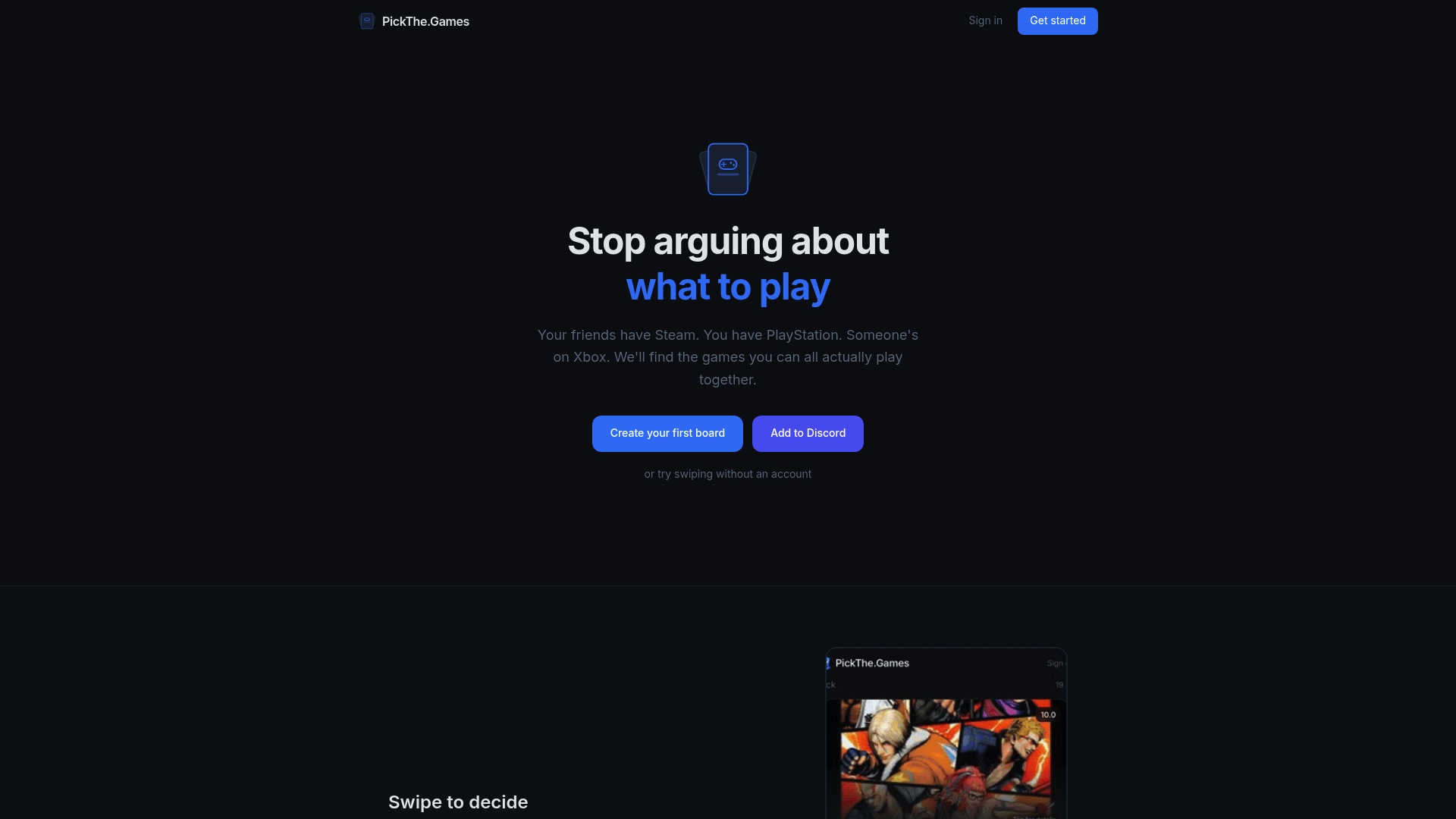
Running an audience-choice segment shouldn't mean juggling three separate tools before you've even gone live. A platform provides creators one board where viewers can swipe through candidate games, a crossplay check to confirm everyone can join, and a Streamer Mode to turn that board into a shareable public vote with a live OBS leaderboard.
A few things make it worth trying for your next stream, including how you can add some fun with juegos para afterwork that entertain your group during breaks or voting segments:
- Fast consensus can be reached through swiping rather than typing numbers into a scrolling chat.
- Crossplay checking helps ensure games chosen can accommodate the audience.
- Streamer Mode features live voting links and leaderboard support, allowing results to show up on-stream without extra overlay building.
Try the game voting app for your next stream, or read how Streamer Mode works before you go live.
Sources
- How to use polls
- Beyond Show of Hands: Engaging Viewers via Expressive and Scalable Visual Communication in Live Streaming (CHI 2021)
- Amazon Interactive Video Service
FAQ
What is an audience choice stream exactly?
An audience choice stream is a live broadcast where viewers vote on what happens next, such as which game to play or which path to take, usually through a chat poll, a voting board or a Discord vote. The result is shown on-screen and the streamer acts on it straight away.
Which platform poll tool should I start with?
If you're new to this, Twitch's built-in polls are the simplest starting point since they run through the Creator Dashboard with no extra setup. For longer candidate lists or crossplay groups, a dedicated voting board like PickThe.Games' Streamer Mode handles more options without cluttering chat.
How do I stop viewers from voting more than once?
Gating votes behind Channel Points, follow age or account requirements cuts down most duplicate voting, and having a moderator keep an eye on the results adds a second layer of protection. For contested results, voiding and rerunning the poll is usually better than letting a disputed outcome stand.
Does showing results on-screen actually improve engagement?
Yes. CHI 2021 research found that aggregating and visualising viewer input helps streamers make sense of the responses and increases how engaged viewers feel, since they can see how others voted rather than just submitting a vote into a void.
What should I do when a vote ends in a tie?
Decide your tiebreaker before voting opens, whether that's a runoff between the tied options, a short timer extension or a coin flip on stream. Announcing the rule in advance keeps the result feeling fair rather than improvised after the fact.