What is a game discovery board: your 2025 guide
What is a game discovery board: your 2025 guide

A game discovery board is a visual, interactive tool that helps you filter, track, and curate games from large catalogues into a manageable shortlist. Think of it as the difference between scrolling endlessly through a storefront and actually landing on something your group wants to play tonight. At its core, a discovery board organises games into structured views, ranging from Kanban-style columns used by development teams to consumer-facing swipeable decks built for players.
Here is what a game discovery board typically does for you:
- Filters titles by genre, player count, platform, or mood so you are not starting from scratch every time
- Tracks your shortlist as you move games from "maybe" to "let's play this"
- Curates recommendations based on your past ratings or group preferences
- Reduces choice overload by presenting one game at a time or a focused set of candidates
- Supports group decisions through shared voting, veto mechanics, or real-time input from everyone in your session
What types of game discovery boards exist?
Game discovery boards come in two distinct forms, and understanding the difference helps you pick the right tool for your situation.
Professional Kanban-style boards are used by product and development teams to manage their backlog. Columns represent stages of refinement, cards represent individual work items, and the whole board gives a team visibility into what is ready for the next sprint. The structure is borrowed directly from Kanban methodology, and it works well for studios tracking which game features or titles are ready to ship. Consumer-facing discovery boards are built for players. These focus on moving you from a broad catalogue to a personal shortlist as quickly as possible. Common features include:- Swipe or rate interfaces that let you react to one game at a time
- Filters for genre, platform, player count, and release date
- Veto mechanics that let any group member block a title that does not work for them
- Real-time voting so everyone contributes simultaneously rather than waiting their turn
- Cross-platform compatibility data so you know upfront whether your group can actually play together
Pickthe is a strong example of the consumer board model. Its platform lets your group browse multiplayer games across PC, PlayStation, Xbox, and Switch, filtering by platform and player count before anyone swipes. The veto system means no one gets steamrolled into a game they cannot run or do not want to play.
Pro Tip: Set your platform filters before you start swiping. It takes ten seconds and saves your group from falling in love with a game half of you cannot access.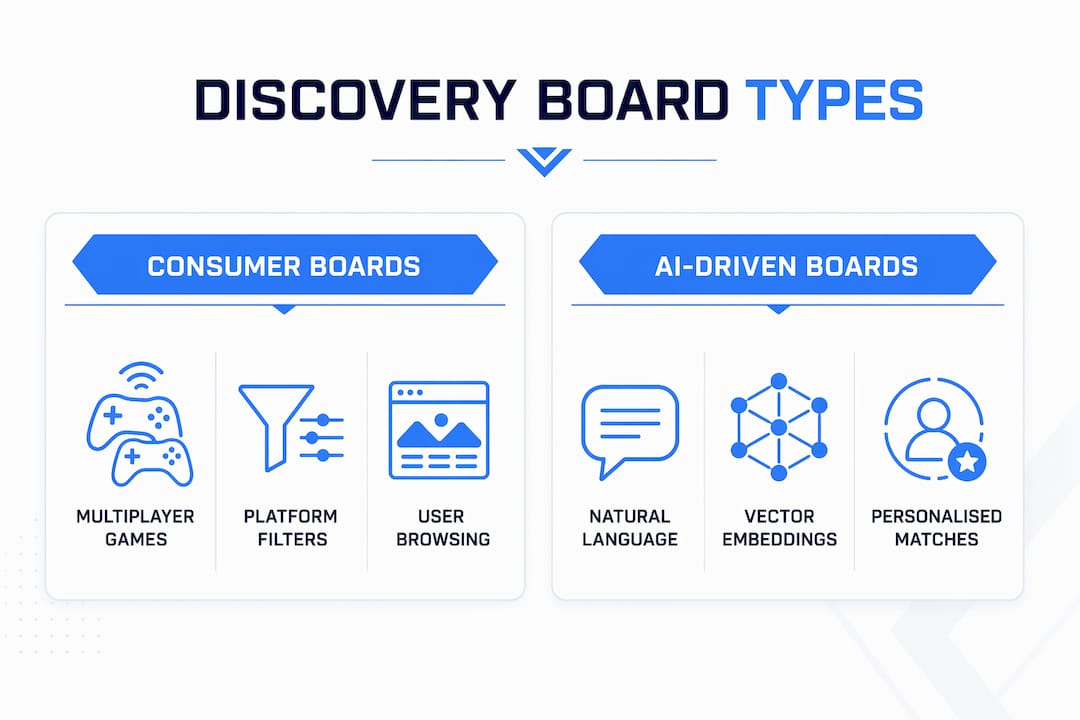 *
*
How is technology reshaping game discovery boards?
The biggest shift in game discovery right now is the move from static tag-based search to AI-driven matching, and the gap between the two approaches is striking.

Traditional search relies on metadata: genre tags, player count fields, release dates. The problem is that this metadata is often brittle. Inconsistent or shallow tagging means a game labelled "action" on one platform might be "action-adventure" on another, and the system cannot connect a player's real preference to the right title. The game exists in the catalogue. The player wants it. The metadata fails to bridge them.
AI-driven tools are changing this. By late 2025, platforms are converting natural language prompts into vector embeddings that match player intent against entire catalogues in seconds. You type "a cosy co-op game with light crafting and no competitive pressure" and the system finds candidates that fit that description, not just titles tagged "co-op." Tools like this search across more than 30,000 Steam titles using a dual-model pipeline that cross-checks results for accuracy.
The broader trend is equally clear: game discovery is evolving from purely algorithmic lists towards community-driven and AI-assisted models with real-time interactions, improving engagement well beyond what passive browsing achieves. Live streaming communities are part of this shift too, with viewer recommendations and streamer playthroughs becoming genuine discovery surfaces alongside traditional storefronts.
Key technological trends shaping discovery boards right now:
- Natural language prompting replaces tag-based keyword search
- Vector embeddings match player mood and mechanics to game catalogues at scale
- Community validation layers surface games through social proof, not just algorithmic ranking
- Real-time interaction keeps players engaged during the discovery process itself
- Structured semantic metadata frameworks, when properly maintained, make every other layer work better
How do discovery boards help your group choose a game?
Multiplayer game selection has a specific problem that solo discovery does not: you need a game that works for everyone at the table, across different platforms, skill levels, and preferences. A discovery board built for groups solves this differently from a personal recommendation engine.
The core challenge is compatibility. Your group might span PC, PS5, and Xbox, and not every game supports crossplay between all three. Without a tool that surfaces this upfront, you spend the first twenty minutes of game night checking store pages and asking "wait, can you actually join from Switch?" That friction kills the mood before anyone has loaded a game.
Pickthe addresses this directly. Its group game voting app pulls crossplay compatibility data from a database of over 6,000 titles, so your group only sees games you can all actually play together. Real-time voting means everyone swipes simultaneously, and the veto system gives each player a genuine say rather than letting the loudest voice win. The whole process takes minutes rather than the usual back-and-forth.
Community and social features matter here too. Discord integration means your group can run the discovery session inside the chat where you are already coordinating, without switching between apps. That kind of friction reduction is exactly what makes a discovery board genuinely useful for groups rather than just theoretically appealing.
- Real-time voting gives everyone equal input
- Veto mechanics prevent anyone being pushed into an incompatible or unwanted game
- Cross-platform filters remove compatibility guesswork before voting starts
- Discord integration keeps the session inside your existing group chat
- A database of over 6,000 games with continuous updates means the catalogue stays current
Why game discovery is a skill worth developing
Treating game discovery as a passive activity, something that just happens when you scroll a storefront, means you miss most of what is worth playing. Educators and industry analysts increasingly frame game discovery as a structured research skill, one that involves evaluating sources critically rather than reacting to what the algorithm surfaces first.
What does that look like in practice? It means going beyond the cover art and the headline review score. Evaluating game metadata as a primary source includes reading patch notes to understand how a game has evolved, checking developer update histories to gauge ongoing support, and weighing community sentiment from forums rather than just aggregate ratings. A game with a 7.2 score and an active developer posting weekly updates is often a better pick than a 7.8 with no patches in eighteen months.
Structured discovery also means using multiple channels rather than one. A storefront feed shows novelty. A press roundup suggests quality. A developer's own posts reveal intent. Community forums surface what the algorithm buries. Combining these layers gives you a much clearer picture than any single source alone.
Skills that define a strong game discovery approach:
- Critical metadata evaluation: reading beyond genre tags to patch notes, complexity scores, and update history
- Multi-source sampling: combining storefronts, press coverage, developer pages, and community forums
- Preference articulation: being specific about what your group wants so filters and AI tools can actually help
- Shortlist discipline: committing to a focused list of candidates before diving into trailers and store pages
- Iterative refinement: treating each discovery session as feedback that sharpens your next search
Key takeaways
A game discovery board is the most practical tool available for cutting through catalogue overload and landing on a game your whole group can actually play.
| Point | Details |
| --- | --- |
| Core definition | A discovery board filters, tracks, and curates games from large catalogues into a focused shortlist. |
| Two main types | Professional Kanban boards manage development backlogs; consumer boards use swipe and vote mechanics for players. |
| AI is changing discovery | Natural language prompts and vector embeddings now match player intent to catalogues far more accurately than tag-based search. |
| Group gaming benefit | Pickthe combines real-time voting, veto systems, and crossplay data to resolve group selection in minutes. |
| Discovery as a skill | Evaluating patch notes, developer history, and community sentiment produces better picks than storefront browsing alone. |