The role of game discovery on consoles in 2026
The role of game discovery on consoles in 2026

Game discovery on consoles is the process by which players find video games suited to their preferences, hardware, and social group. The role of game discovery on consoles has never mattered more: indie titles without editorial featuring often sell fewer than 500 copies in their launch week. That figure shows how brutally visibility shapes a game's fate. Console storefronts have evolved well beyond passive digital shelves, and the systems that surface games now directly influence which multiplayer communities form, which titles survive, and how your group spends its next game night.
How consoles use algorithms and curated ecosystems to recommend games
Console storefronts have shifted from one-time sales models to curated ecosystems built around long-term player retention. PlayStation and Xbox no longer simply list games alphabetically. They actively steer you toward titles that align with your subscription tier, your play history, and the platform's commercial priorities. That shift changes everything about how you find your next game.Personalised recommendation rails sit at the heart of this model. The system tracks what you play, how long you play it, and what you browse without buying. It then surfaces titles with similar genre tags, multiplayer modes, or price points. The result feels helpful, but it also means the algorithm reinforces existing habits rather than broadening your taste.

Subscription services like Xbox Game Pass integrate discovery directly into the retention loop. When a game is included in your subscription, the barrier to trying it drops to zero. Publishers know this, so they design launch strategies around subscription inclusion as a discovery mechanism rather than relying solely on storefront placement.
Editorial collections and seasonal promotions still carry real weight. A "best multiplayer games" collection curated by a platform editor reaches players who are not actively searching. Seasonal sales create urgency that pushes titles up the visibility ladder for a short window.
The trade-off is real, though. Highly curated ecosystems favour titles with existing commercial relationships. Smaller multiplayer games without publisher backing often get buried regardless of quality.
- Recommendation rails surface games based on play history and genre tags.
- Subscription inclusion lowers the barrier to trying new multiplayer titles.
- Editorial collections reach passive browsers who are not actively searching.
- Seasonal promotions create short-term visibility spikes for qualifying titles.
- Curated ecosystems can disadvantage smaller games without platform partnerships.
Do streamers and community channels drive console game discovery?
External platforms now rival in-console systems as discovery engines. Nearly 33% of developers no longer expect traditional storefront promotions to be the primary driver for a global game launch. That is a significant shift in where the industry believes attention actually lives.
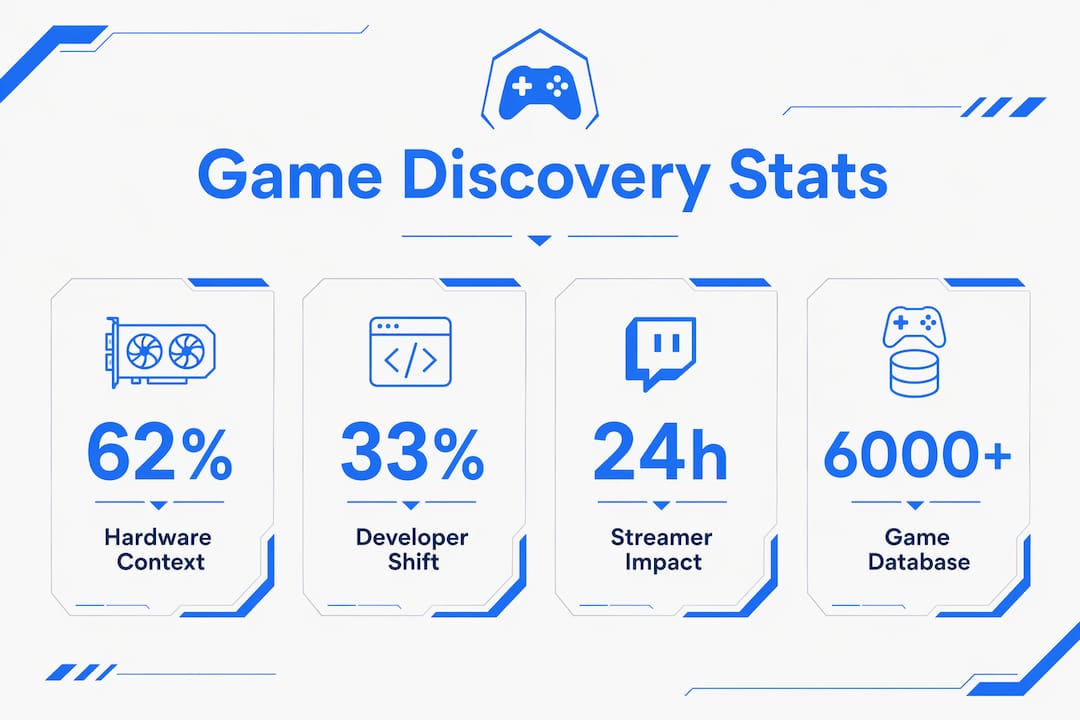
Streamers are the clearest example. A single notable playthrough on Twitch or YouTube can trigger a sales spike within 24 hours that outweighs weeks of storefront featuring. For multiplayer titles especially, watching a group of friends play together on stream creates an immediate social pull. You do not just want the game; you want that experience with your own group.
YouTube and Discord function as persistent discovery hubs in ways that console storefronts cannot replicate. A YouTube video from two years ago still surfaces in search results. A Discord server for a niche multiplayer game keeps recommending titles to its members long after launch week. These channels build discovery momentum that compounds over time.
The problem is that console store quality suffers from metadata squatting, where low-quality titles flood stores using popular keywords and genre tags. This clogs search results and makes organic discovery harder for legitimate games. Players increasingly bypass the storefront entirely and use independent trackers, community wikis, and curated platforms to find multiplayer-compatible titles.
> "Players often must use external trackers and community recommendations for true discovery, especially of niche multiplayer games. Console discovery algorithms are opaque and rely heavily on curated partnerships rather than purely behavioural data."
The practical steps players now take to find good multiplayer games look like this:
1. Watch a streamer play the game with a group to gauge the social experience.
2. Check a community wiki or co-streaming compatibility guide for crossplay details.
3. Search Discord servers dedicated to the genre for honest player recommendations.
4. Use independent game trackers to filter by multiplayer mode and platform support.
5. Cross-reference with a curated platform to confirm your group's hardware compatibility.
How does hardware affect game discovery and multiplayer compatibility?
Hardware context shapes discovery outcomes more than most players realise. Approximately 62% of consumer searches for console games include explicit hardware context, such as "Switch 1 vs Switch 2" or "PS5 exclusive." That figure tells you that players are not just searching for games. They are searching for games that work well on their specific device.
This matters enormously for multiplayer. A game that runs at a stable frame rate on one console may perform poorly on another. When your group spans multiple hardware generations, discovery becomes a compatibility problem as much as a preference problem. Players who search with hardware context experience less discovery fatigue and find multiplayer titles with better local and online support for their device.
UI design directly influences whether discovery converts to play. Redesigned console dashboards reduce friction, clarify visual hierarchy, and surface relevant multiplayer titles more effectively. A well-designed recommendation rail with clear multiplayer badges and crossplay icons removes the guesswork from choosing a game your whole group can join.
Metadata quality is the hidden variable. Games with clear, accurate tags for "local co-op," "crossplay," and "split-screen" appear in the right filtered searches. Games with vague or missing metadata get skipped, even when they are exactly what your group needs.
| Discovery factor | Impact on multiplayer compatibility |
| --- | --- |
| Hardware-specific search | Reduces incompatible results and discovery fatigue |
| UI visual hierarchy | Surfaces crossplay and co-op badges at a glance |
| Accurate metadata tags | Ensures correct filtering for local and online modes |
| Subscription integration | Lowers barrier to trying new multiplayer titles |
Pro Tip: When searching for multiplayer games on any console store, add your specific hardware model to the search term. "Co-op Switch 2" returns more relevant results than "co-op games" alone.How does game discovery enhance multiplayer collaboration on consoles?
Discovery is the gateway to multiplayer community formation. You cannot play a game with your group if half of them have never heard of it. The systems that surface games to the right players at the right moment are what make multiplayer sessions happen at all.
Social proof mechanisms built into console dashboards accelerate this process. Friend activity feeds show what your contacts are playing right now. Live event highlights surface time-limited multiplayer modes. These signals create natural conversation starters and pull groups toward shared experiences without anyone having to do manual research.
Finding games everyone can play across different platforms is one of the hardest parts of organising group play. Discovery systems that include crossplay filters and hardware compatibility information directly reduce the friction of forming a group. When the storefront or external platform tells you upfront that a game supports crossplay between PS5 and PC, your group can commit to it without a lengthy compatibility discussion.Curated multiplayer game listings serve a specific function here. A list labelled "best games for groups of four" does more useful work than a generic top-sellers chart. It matches discovery intent to social context, which is exactly what multiplayer gamers need.
- Friend activity feeds create organic discovery through social proof.
- Live event highlights surface time-limited multiplayer opportunities.
- Crossplay filters reduce compatibility friction when forming mixed-platform groups.
- Curated multiplayer lists match discovery intent to group size and play style.
- Sustained discovery engagement builds communities around specific titles over time.
The long-term effect is community growth. Games that are easy to discover, easy to share, and easy to join with friends retain players far longer than technically superior titles that are hard to find. Discovery quality and multiplayer retention are directly linked.
Key takeaways
Console game discovery is the single biggest factor separating games that build thriving multiplayer communities from those that disappear after launch week.
| Point | Details |
| --- | --- |
| Algorithms shape what you find | Console recommendation systems prioritise subscription alignment and play history over pure quality. |
| External channels outperform storefronts | Streamers and Discord communities drive discovery more reliably than platform featuring for many titles. |
| Hardware context improves results | Including your specific device in searches reduces incompatible results and discovery fatigue. |
| Metadata quality determines visibility | Accurate co-op and crossplay tags are what put multiplayer games in front of the right players. |
| Discovery drives multiplayer retention | Games that are easy to find and share with friends build larger, longer-lasting communities. |
My honest take on where console discovery is heading
The storefront-first era of console discovery is effectively over. I have watched the shift happen gradually, and the pattern is clear: the players who find the best multiplayer experiences are the ones who treat in-console tools as a starting point, not a final answer.
What strikes me most is how passive discovery still dominates player behaviour, even though active discovery consistently produces better results. Most players scroll the homepage, see what is promoted, and stop there. The players who go further, who check Discord, watch a streamer, or use a group game board to align their group's preferences, end up with far more satisfying game nights.
Developers who embed discoverability into their game design from day one, through referral incentives, social sharing hooks, and clear multiplayer metadata, are the ones whose games build communities. The ones who treat discovery as a marketing afterthought rarely recover from a quiet launch week.
My advice to your group: use the console store to browse, but make your final decisions based on community signals. A game that a Discord server is actively talking about in 2026 is almost always a better multiplayer bet than whatever is on the featured banner this week.
> — Pickthe
Finding your group's next game with Pickthe
Picking a multiplayer game that works for everyone in your group is genuinely hard, especially when your friends are on different consoles.

Pickthe has a database of over 6,000 games, all searchable by platform, genre, and crossplay support. You can browse multiplayer games filtered by PS5, Xbox, Switch, and PC, or use the crossplay compatibility checker to confirm what your whole group can actually play together. If you want a faster way to decide, the game night picker lets your group swipe through options and vote in real time, so you spend less time debating and more time playing. For groups who love platformers, the best platformer multiplayer games page is a solid place to start.
FAQ
What is game discovery on consoles?
Game discovery on consoles is the process by which players find and access games suited to their preferences, hardware, and group. It includes in-console algorithms, editorial curation, subscription services, and external channels like YouTube and Discord.
How do console game recommendation algorithms work?
Console recommendation algorithms track play history, browsing behaviour, and genre preferences to surface relevant titles. They also factor in subscription tier and commercial partnerships, which means promoted titles are not always the best fit for your group.
Why does hardware context matter for game discovery?
62% of console game searches include explicit hardware context because performance and multiplayer support vary significantly between devices. Searching with your specific console model returns more compatible results.
How do streamers influence console game discovery?
Streamer visibility can trigger major sales spikes within 24 hours, often outpacing weeks of storefront featuring. For multiplayer games, watching a group play on stream creates direct social motivation to buy and play with friends.
How can I find multiplayer games compatible with my group's consoles?
Use crossplay filters on console storefronts, check community wikis for compatibility details, and use dedicated tools like Pickthe's find games for your group feature to match titles to everyone's hardware at once.