How group game preference matching works in 2026
How group game preference matching works in 2026

Group game preference matching is the method of aggregating players' individual game interests and technical setups to find multiplayer experiences that best suit the whole group. The recognised industry term for this process is preference aggregation, and it sits at the intersection of voting mechanics, crossplay compatibility, and matchmaking algorithms. Getting it right transforms a 30-minute argument into a two-minute decision. Platforms like Pickthe now handle this automatically, drawing on databases of over 6,000 games and real-time crossplay checks across PC, PS5, Xbox, and Nintendo Switch to surface games your whole group can actually play together.
How group game preference matching works: the core mechanics
Group preference matching begins with one simple question: what does each person in your group actually want to play? The challenge is that individual answers rarely align, and the traditional approach of asking in a group chat produces a predictable result. One or two dominant voices steer the conversation, quieter members disengage, and the group ends up playing whatever the loudest person suggested. Messy decision-making is widely recognised as the biggest obstacle to enjoyable group gaming, not a lack of game choice.
Modern preference aggregation tools replace that chaos with a structured process. Each group member independently rates games through a swiping interface, voting yes, no, maybe, or ban on each title. The system then aggregates those votes across the group and surfaces the games with the highest collective approval. Because everyone votes privately before results are revealed, no single person's enthusiasm or hesitation influences anyone else's choices.
The aggregation step is where the real work happens. A simple majority vote counts yes responses. A weighted system factors in the strength of preference, giving a strong yes more influence than a lukewarm maybe. A veto or ban mechanic removes any game that one or more members actively reject, which prevents the group from being pushed into something genuinely unpopular. Pickthe uses all three of these mechanisms together, which is why it produces results the whole group can accept rather than just tolerate.
 Pro Tip: Set your platform filters before anyone starts swiping. Filtering by platform first means your group only votes on games they can technically access, which cuts the list down and speeds up the whole process considerably.
How does crossplay compatibility affect game selection?
Cross-platform compatibility is the most underestimated technical constraint in group game matching. Most groups assume that if a game supports crossplay, everyone can play together. That assumption is frequently wrong. Crossplay support operates at the platform pair level, not as a blanket feature. A game might support PC and Xbox crossplay but exclude PlayStation 5, meaning a group with mixed hardware still cannot play together.
The practical consequence is that filtering for technical feasibility before evaluating preferences prevents a common and frustrating failure mode: the group agrees on a game, someone tries to join, and the session collapses because the platforms are incompatible. Availability mismatch, where a game is technically available on all platforms but lacks crossplay between specific pairs, causes a significant proportion of group decision failures.
The table below illustrates how crossplay support varies across common platform pairs, which is exactly the kind of filtering a good preference matching tool applies automatically.
| Platform pair | Crossplay support | Notes |
| --- | --- | --- |
| PC and Xbox | Common | Many titles support this pair natively |
| PC and PS5 | Moderate | Supported in a growing number of titles |
| Xbox and PS5 | Moderate | Improving but not universal |
| PC and Nintendo Switch | Limited | Fewer titles support this combination |
| PS5 and Nintendo Switch | Rare | Supported in a small number of titles |
Pickthe's crossplay compatibility checker handles this filtering automatically. You select the platforms your group owns, and the tool removes any game that cannot connect those specific pairs. The result is a shortlist of games that are genuinely playable by everyone, before a single vote is cast.
What role do matchmaking algorithms play in group game selection?
Matchmaking algorithms and preference aggregation solve related but distinct problems. Preference aggregation answers "what should we play?" Matchmaking algorithms answer "who should play together, and under what conditions?" Understanding both is useful because many group gaming sessions involve both decisions.
Technical matchmaking systems use sliding window mechanics to balance skill and network quality. A typical implementation restricts matching by skill rating within a defined range, such as ±50 MMR, then expands that window by 25 points every two seconds until a match is found, up to a maximum of ±300. Latency is handled similarly, with matches above 80 ms avoided until tolerance is expanded. This prevents both unfair skill gaps and laggy sessions.
The key points about how these algorithms function in practice:
- Skill window expansion prevents indefinite queuing by gradually widening the acceptable skill range over time.
- Latency thresholds protect session quality by prioritising low-ping matches before relaxing network requirements.
- Bot reduction directly improves match quality. Reducing AI-powered bot use by 3% measurably improves the matchmaking experience.
- Engagement optimisation is a measurable output. Advanced matchmaking policies increase player engagement by 4%–6% over traditional skill-only methods.
The contrast with social preference matching is significant. Algorithmic systems maximise quantifiable fairness. They are excellent at balancing skill levels and minimising wait times across large player pools. However, TrueSkill-style algorithms struggle to quantify psychological satisfaction in small private groups, where the social dynamic matters as much as the skill balance.
Pro Tip: For private friend groups, prioritise preference aggregation over skill-based matchmaking. Your group already knows each other's skill levels. What you need is a fair way to agree on what to play, not an algorithm designed for anonymous public queues.Why do social dynamics shape group game matching outcomes?
The most technically correct game selection can still fail if the group does not feel heard. Social cohesion often matters more than game quality for overall enjoyment. Players consistently report preferring a mediocre game with people they like over a technically superior game with a difficult group. This means the process of choosing a game carries as much weight as the choice itself.
Fair voting systems reduce group friction in a specific and measurable way. When one person is responsible for picking the game, they carry the social burden of that decision. If the group does not enjoy it, the blame lands on that individual. Blind swiping systems remove that burden entirely, distributing responsibility across the group and eliminating guilt and dominant personality bias. The result is higher group harmony before the session even begins.
Common social challenges in group game matching, and the strategies that address them:
- Dominant personality bias. One person's enthusiasm drowns out quieter members. Anonymous voting prevents this.
- Decision fatigue. Long lists of options exhaust groups before they agree. Platform filtering and database limits reduce the choice pool to a manageable size.
- Compromise resentment. Someone always feels they gave up their preference. A veto mechanic ensures no one is forced into a game they actively dislike.
- Rotating fairness. Some groups rotate who picks the game each session. Preference tools make this unnecessary by giving everyone equal input every time.
The democratic game picking approach works because it separates the social act of choosing from the technical constraints of what is actually playable. Both problems are solved in the same workflow, which is why groups that use structured preference matching report fewer arguments and faster starts.
How to implement group game preference matching for your group
Putting preference matching into practice takes less time than most groups expect. The workflow below works for any group size, from three friends to a full Discord server.
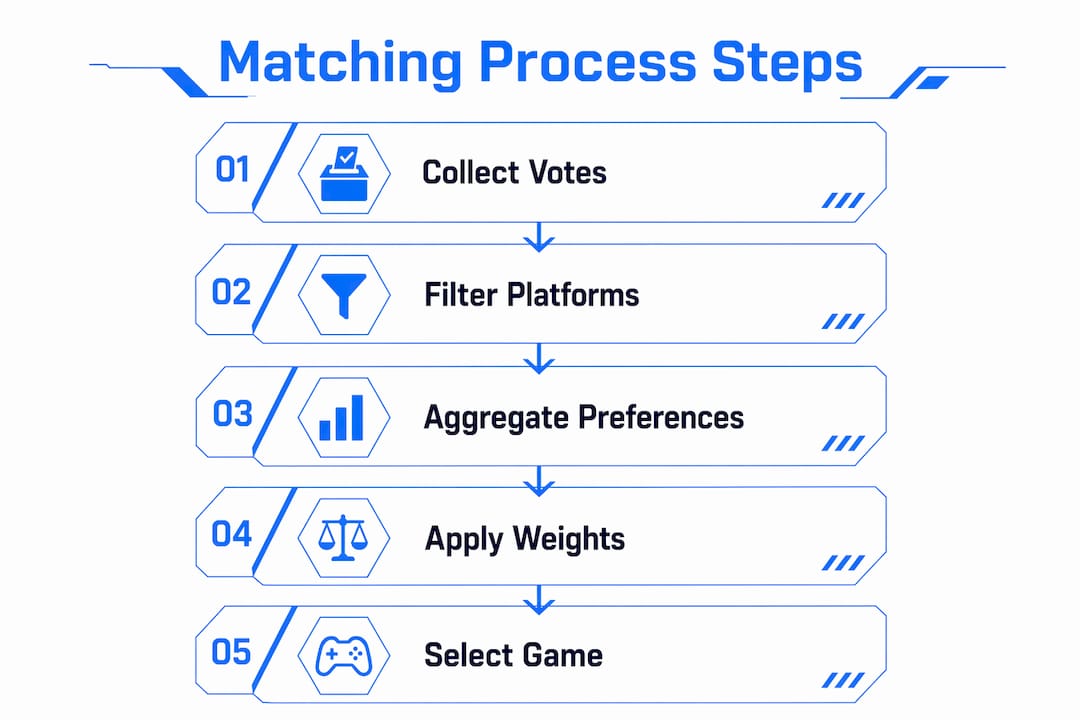
1. Create a shared session. One person sets up a board or session on a preference matching tool and shares the link with the group. No account creation is required on Pickthe.
2. Select your platforms. Each member confirms which platforms they own. The tool filters the game database to show only titles compatible with the group's hardware.
3. Swipe and vote. Everyone independently swipes through the filtered game list, voting yes, no, maybe, or ban on each title. This takes two to three minutes per person.
4. Review the aggregated results. The tool surfaces games ranked by collective approval, with any vetoed titles removed. The top result is the group's best match.
5. Connect via Discord. Pickthe integrates with Discord, so you can run the entire session inside a voice or text channel without switching apps. The Discord game picker guide covers the setup in detail.
6. Start playing. With a compatible, agreed-upon game selected in minutes, your group spends its time playing rather than debating.
Separating objective constraints from subjective preferences is the key principle behind this workflow. Platform compatibility is an objective filter applied first. Personal taste is a subjective input applied second. Keeping those two steps in order prevents the most common failure mode in group game selection.Key takeaways
Group game preference matching works best when objective technical filters are applied before subjective voting, giving every group member equal and anonymous input into the final decision.
| Point | Details |
| --- | --- |
| Preference aggregation is the core process | Collecting and combining individual votes produces fairer outcomes than group chat decisions. |
| Crossplay filtering must come first | Removing incompatible games before voting prevents wasted time and session failures. |
| Algorithms serve large pools; social tools serve friend groups | TrueSkill-style systems maximise fairness at scale but miss psychological satisfaction in private sessions. |
| Blind voting removes social pressure | Anonymous swiping eliminates dominant personality bias and distributes decision responsibility across the group. |
| Discord integration speeds up the workflow | Running preference matching inside Discord removes friction and keeps the group in one place. |
What I have learned from watching groups actually use these tools
The thing that surprises most groups the first time they use a structured preference matching tool is how quickly the argument disappears. Not because the tool is clever, but because it removes the social awkwardness of saying "I don't want to play that." A swipe is anonymous. A veto is just data. Nobody feels judged for their preferences, and nobody feels responsible for the group's disappointment if the top result turns out to be a poor session.
What I find genuinely interesting is how the technology has shifted the conversation. Groups used to spend 20 minutes debating games and five minutes playing. Now they spend two minutes matching and the rest of the evening actually gaming together. That is not a small improvement. It is a fundamental change in how groups experience game night.
The algorithmic side of this is often overstated in technical discussions. Sliding window MMR and TrueSkill variants are powerful tools for matchmaking at scale, but they are not what your friend group needs on a Friday evening. What your group needs is a fair, fast way to agree on something everyone can access and nobody actively hates. That is a social problem with a social solution, supported by a bit of well-designed technology.
Platforms like Pickthe get this balance right. The technology handles the objective constraints quietly in the background, and the voting mechanic handles the social dynamics in a way that feels natural rather than mechanical. The best version of group game matching is one where the group barely notices the process at all. They just end up playing something they all enjoy.
> — Pickthe
Ready to find your group's next game in minutes?
Pickthe is a free, browser-based tool built specifically for this problem. Your group creates a shared session, selects your platforms, and swipes through a database of over 6,000 games. The crossplay checker filters out incompatible titles automatically, and the voting system surfaces the game your group actually wants to play.

Whether your group is into party multiplayer games or you prefer something more persistent like MMO multiplayer games, Pickthe has the catalogue and the tools to match your group's preferences without the argument. No paywall, no account required. Just share the link and start swiping.
FAQ
What is group game preference matching?
Group game preference matching is the process of collecting each player's individual game interests and platform capabilities, then aggregating those inputs to identify the best multiplayer game for the whole group. It combines voting mechanics, crossplay filtering, and preference algorithms to produce a fair, fast result.
How does crossplay compatibility affect the matching process?
Crossplay support operates at the platform pair level, not as a blanket feature. A game may support PC and Xbox crossplay but exclude PS5, so filtering by specific platform pairs before voting is critical to avoid session failures.
Why is blind voting better than group chat for game selection?
Blind swiping systems remove dominant personality bias by keeping each member's votes private until results are revealed. This gives quieter group members equal influence and eliminates the social pressure that skews chat-based decisions.
Do matchmaking algorithms work for private friend groups?
Algorithms like TrueSkill maximise fairness quantitatively but struggle with psychological satisfaction in small private groups. Social voting tools consistently outperform pure algorithms for friend group happiness, making preference aggregation the better choice for game nights.
How long does group preference matching take with a dedicated tool?
Pickthe reduces game selection from hours to minutes. Each member swipes through a filtered game list in roughly two to three minutes, and the aggregated result is available immediately after everyone has voted.