What is a group game match system?
What is a group game match system?
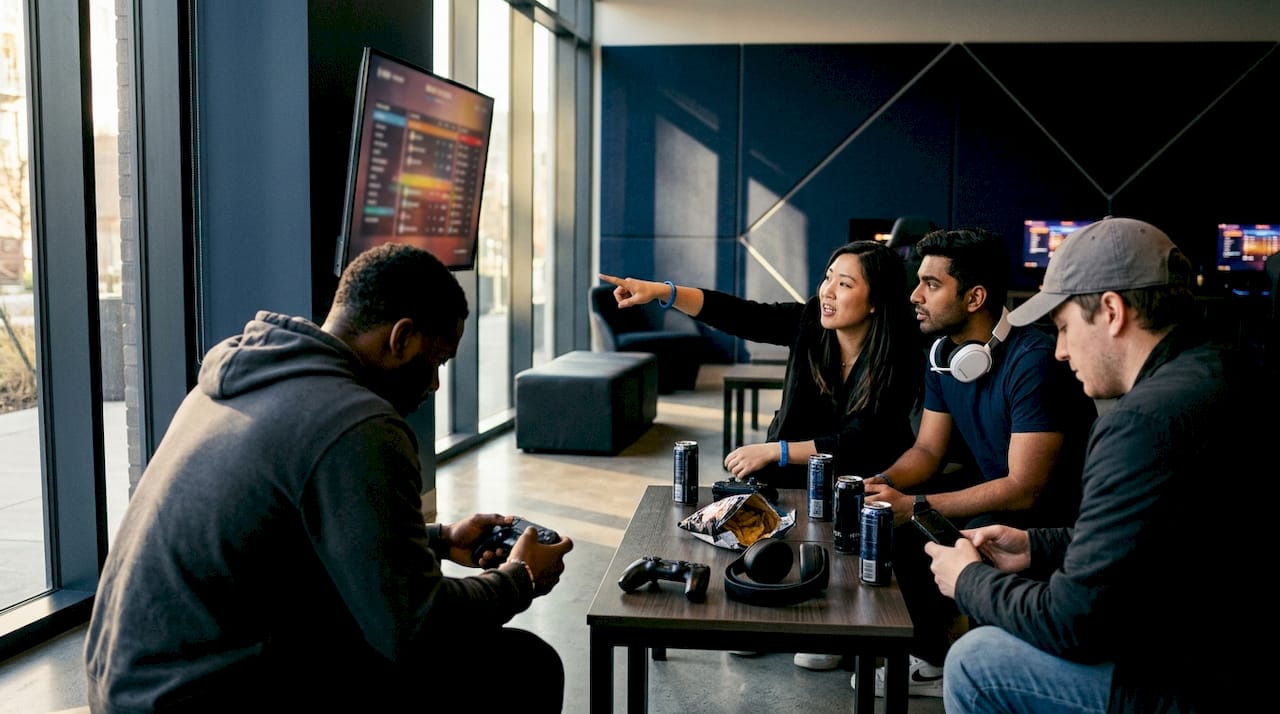
A group game match system is the automated infrastructure that organises players or parties into balanced multiplayer sessions based on skill rating, latency, and mode preferences. If your group has ever spent more time arguing about what to play than actually playing, you already understand why these systems matter. They sit quietly behind every lobby screen, doing the heavy lifting so your group lands in a fair, well-matched game without the faff. This article breaks down how the match system works, what formats it supports, and how your group can get the most from it.
What is a group game match system, exactly?
A group game match system is defined as the process that connects players or parties) into game sessions using criteria such as skill rating, latency, and game mode preference. The system does not simply throw random players together. It evaluates each request against a pool of other requests and applies a ruleset to find the most balanced possible grouping.
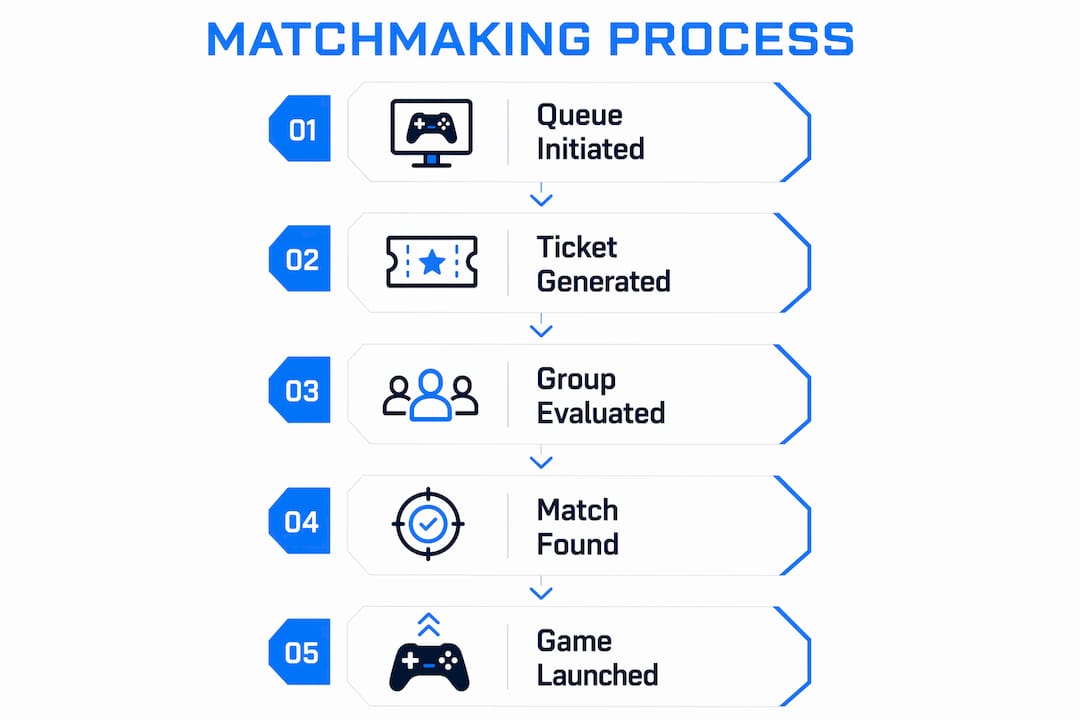
The key unit inside any match system is the match ticket. When you queue up solo, the system generates one ticket for you. When your group queues together, a party leader submits one ticket that covers every member of the party. That single ticket prevents the system from splitting your friends across different lobbies, which is the most common frustration in group play.

Parties are treated as atomic entities throughout the entire process. That means the system either places your whole group together or keeps you in the queue. It never breaks the party apart to fill gaps in other sessions.
How does a group game match system work technically?
The technical pipeline behind group matchmaking has several distinct stages. Understanding them helps you set realistic expectations about queue times and match quality.
1. Ticket creation. You or your party leader submits a match request. The system generates a ticket containing your group's attributes: skill rating, preferred game mode, region, and party size.
2. Queuing. Your ticket enters a pool alongside other active tickets. The matchmaker continuously scans this pool, grouping tickets that meet the match ruleset for the current mode.
3. Logic evaluation. The system applies the ruleset, checking skill balance, latency thresholds, and group size constraints. Tickets that do not meet the criteria stay in the queue until a better match appears or the criteria relax over time.
4. Server reservation. Once a valid grouping is found, the system reserves a game server instance for that session. In distributed platforms, shared coordination services) such as MemoryStore and MessagingService handle communication across multiple server instances simultaneously.
5. Teleportation to the session. All matched players receive a connection signal and transfer into the live game instance together. The group arrives as a unit, preserving party integrity from lobby to live play.
Pro Tip: If your queue times are unusually long, your group size is likely the bottleneck. Larger parties narrow the pool of valid matches. Reducing party size by one or two players often cuts wait times significantly.The coordination layer is what separates modern matchmaking from older peer-to-peer systems. Platforms that use dedicated services to synchronise server state across instances produce far more consistent group experiences than those relying on a single host machine.
What are common group match formats and rules?
The group game format you choose shapes the entire experience, from how many matches each player gets to how disputes are resolved. The two most widely used structures are the round robin group stage and the knockout bracket, and most serious tournaments combine both.
Round robin group stage
In a round robin group stage, every team or player in a group faces every other member at least once. This format guarantees a minimum number of matches per participant, which is why it dominates the opening phase of major esports events and traditional tournaments alike. The standard points system awards 3 points for a win, 1 for a draw, and 0 for a loss. Top finishers advance to the knockout phase.
Knockout rounds
Knockout rounds follow the group stage and produce decisive results quickly. Single elimination means one loss ends your run. Double elimination gives players a second chance through a losers' bracket before final elimination. Knockout formats create high-stakes moments that round robin play cannot replicate.
Tiebreakers and common pitfalls
Tiebreakers are where most amateur tournaments fall apart. Failing to define tiebreakers before the event starts causes disputes that derail entire competitions. A formal tiebreaker order should be established in advance. A widely accepted sequence is:
- Points total (primary)
- Head-to-head result between tied teams
- Goal difference or score differential
- Total goals or kills scored
- Coin toss or random draw as a last resort
Group sizes and scheduling
Group size directly affects scheduling complexity. Groups of 3 to 5 participants produce manageable round robin phases with minimal scheduling conflicts. Twelve participants is widely considered a practical target for tournament design because four groups of three yield perfectly balanced schedules without byes. A bye, where one team sits out a round because of an odd number of participants, disrupts rhythm and creates unfair rest advantages.
| Group size | Matches per participant | Scheduling complexity | Bye risk |
|---|---|---|---|
| 3 teams | 2 | Low | None |
| 4 teams | 3 | Low | None |
| 5 teams | 4 | Medium | None |
| 6 teams | 5 | High | None |
| 7 teams | 6 | Very high | Present |
How does skill and balance factor into group matchmaking?
Skill-based matchmaking, commonly abbreviated as SBMM, is the mechanism that keeps matches competitive rather than one-sided. The goal of SBMM is straightforward: place players of similar ability in the same session so that the outcome depends on performance rather than a mismatch in baseline skill.
How SBMM handles parties
Parties complicate SBMM because a group of five players rarely has identical skill ratings. The system must calculate a representative value for the whole party and find opponents whose combined rating is comparable. Different games handle this differently. Some use the average rating of the party. Others use the highest individual rating to prevent high-skill players from carrying lower-rated friends into mismatched lobbies.
Mode-specific rulesets
Distinct match rulesets per game mode are necessary to avoid player frustration and churn. A Ranked mode ruleset prioritises tight skill brackets and accepts longer queue times to achieve balance. A Social or Casual mode ruleset widens the skill bracket and prioritises speed, filling lobbies quickly even if the skill spread is broader. Applying a Ranked ruleset to a casual mode frustrates players who just want a quick game. Applying a casual ruleset to Ranked undermines competitive integrity.Tentative matching and iterative refinement
High-quality matchmakers do not lock in groupings immediately. Tentative matches allow continuous re-evaluation until the most balanced outcome is found. The system proposes a grouping, checks whether a better combination exists in the current pool, and adjusts before finalising. This iterative process is not a delay. It is the mechanism that produces fairer results.
1. The system proposes an initial grouping from available tickets.
2. It checks whether swapping any ticket produces a more balanced outcome.
3. It repeats the evaluation until no improvement is possible.
4. The final grouping is confirmed and server reservation begins.
Latency and geographic considerations
Skill balance alone does not produce a good match. A perfectly balanced lobby with players spread across three continents will feel broken because of latency. Modern matchmakers apply geographic filters alongside skill filters, prioritising players within a defined ping threshold. Your group's physical location affects which pool you enter and how long you wait.
What practical tips help gamers use group match systems effectively?
Getting the most from a group match system requires a bit of preparation before you even hit the queue button. These habits make a real difference.
- Form your party before queuing. Joining a queue solo and hoping to find friends mid-match is unreliable. Assemble your group in a voice channel or chat first, then queue together as a party.
- Match your game mode to your group's goal. If your group includes players of very different skill levels, a Social mode queue produces better experiences than a Ranked queue where SBMM will struggle to place you fairly.
- Communicate expected wait times. Larger parties face longer queues. Let your group know upfront so nobody drops out of the party during the wait and breaks the ticket.
- Avoid odd group sizes in organised events. If you are running a tournament, aim for participant counts that divide evenly into groups of 3 or 4. Twelve, sixteen, and twenty-four are clean numbers that avoid byes entirely.
- Set rules before play, not during. Whether you are running a casual game night or a structured bracket, agree on win conditions, tiebreakers, and any platform-specific rules before the first session starts.
- Account for cross-platform differences. Players on PC, console, and mobile may face different input methods and performance characteristics. If your group spans platforms, check crossplay settings and agree on any input restrictions in advance.
Platform-specific coordination is the most underrated challenge in group gaming. Two players on different consoles may not even see each other in the same matchmaking pool unless crossplay is explicitly enabled on both sides.
Key takeaways
A group game match system works best when your group understands its mechanics and prepares accordingly. Parties that queue together, choose the right mode, and set clear rules before play consistently have better experiences than those who improvise.
| Point | Details |
|---|---|
| Match tickets preserve group integrity | A single party ticket prevents the system from splitting your group across different lobbies. |
| Mode-specific rulesets matter | Ranked and Social modes use different criteria; choosing the wrong mode produces poor matches. |
| Tiebreakers must be set in advance | Defining points, head-to-head, and goal difference order before play prevents disputes. |
| Group size affects queue time | Larger parties narrow the valid match pool and increase wait times noticeably. |
| Twelve is the cleanest tournament number | Four groups of three avoid byes and produce balanced schedules without scheduling conflicts. |
Pickthe's take on where group matchmaking is heading
Group matchmaking has improved enormously over the past decade, but the gap between what the technology can do and what most groups actually experience is still wide. The biggest gains have come from treating parties as atomic units and from mode-specific rulesets. Both of these were not standard practice ten years ago, and their adoption has made casual group play genuinely more enjoyable.
The area I find most interesting right now is the iterative tentative matching approach. Most players assume matchmaking is a single calculation. The reality is that well-designed systems run multiple evaluation passes before locking in a grouping. That extra computation produces meaningfully fairer matches, and as server infrastructure becomes cheaper, more platforms will adopt it.
The next frontier is cross-platform group coordination. Skill rating and latency are largely solved problems. Getting a group of friends on PC, PlayStation, and Xbox into the same lobby, playing the same game, with fair input settings, is still harder than it should be. Tools that sit above the platform layer and handle the coordination work are going to become increasingly important for group gaming. That is exactly the problem Pickthe was built to address.
> — Pickthe
How Pickthe helps your group find the right match
Finding a game your whole group can play together is often harder than the match itself.
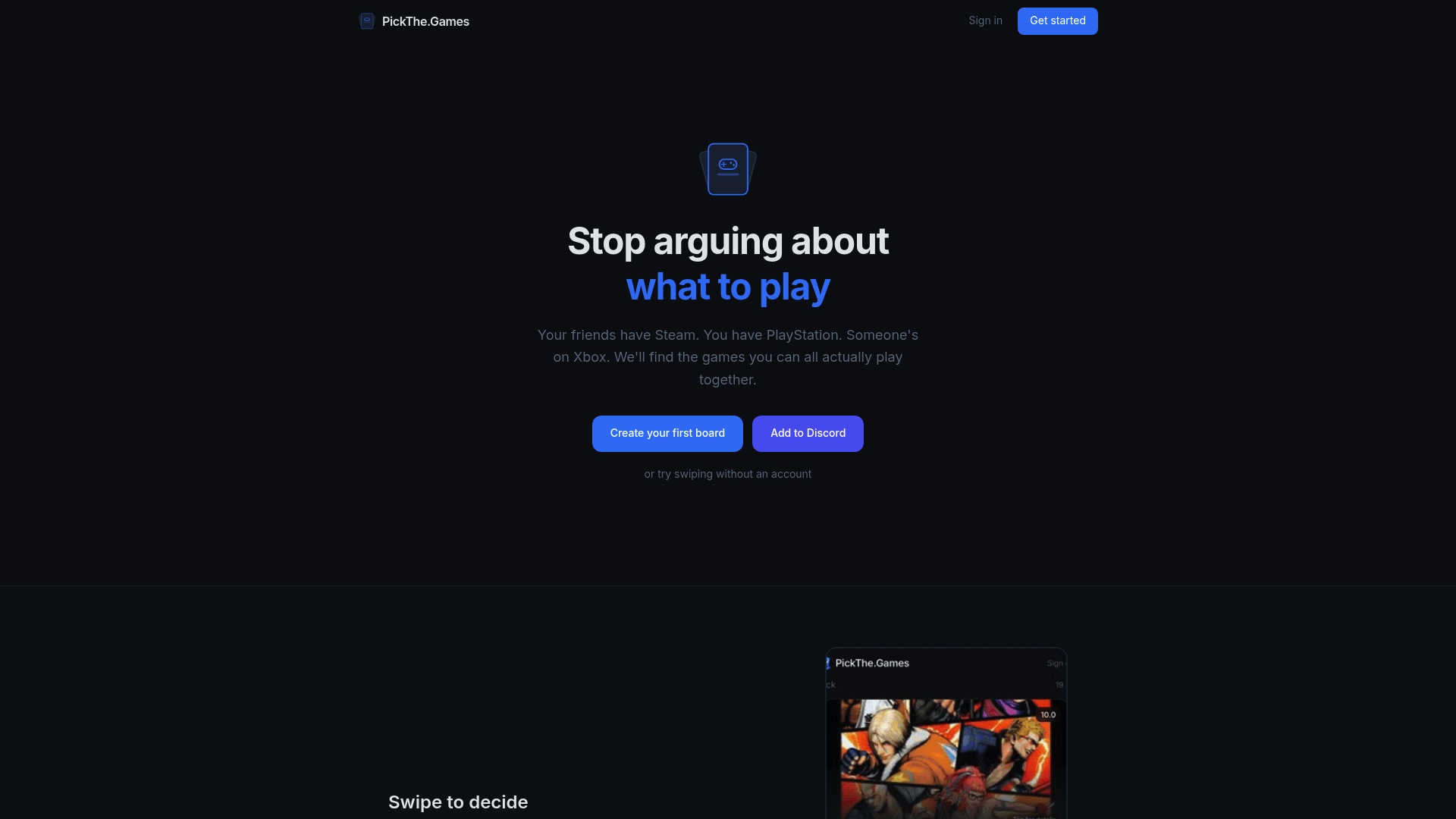
Pickthe solves the pre-game coordination problem that no matchmaking algorithm addresses. Your group creates a board, swipes through games from a catalogue of over 6,000 titles, and the platform identifies which ones work across everyone's platforms. Real-time voting and a veto system mean every player has equal input, and the whole process takes minutes rather than an hour of back-and-forth in chat. Discord integration keeps it inside your existing workflow. Visit Pickthe to find your group's next game without the argument.
FAQ
What is a group game match system in simple terms?
A group game match system is the automated process that places players or parties into balanced multiplayer sessions based on skill, latency, and game mode. It uses match tickets to keep groups together from queue to live game.
How does a match ticket work for a party?
A party leader submits one match ticket that covers all party members. The system treats the entire party as a single unit, preventing any member from being placed in a different lobby.
What is the best group size for a tournament?
Groups of 3 to 5 participants work best for round robin phases. Twelve total participants split into four groups of three is widely considered the cleanest tournament structure because it eliminates byes entirely.
Why do queue times increase with larger parties?
Larger parties require the matchmaker to find enough opponents with comparable combined skill ratings and similar latency. The narrower the valid match criteria, the fewer tickets in the pool qualify, which extends the wait.
What tiebreaker order should a group tournament use?
The standard tiebreaker sequence is points total, head-to-head result, goal or score difference, total goals or kills scored, and then a random draw. Establishing this order before the event starts prevents disputes mid-competition.