How online game selection platforms work in 2026
How online game selection platforms work in 2026

Online game selection platforms are metadata-driven recommendation engines that analyse game attributes and user behaviour to surface the right game for the right group at the right moment. Understanding how online game selection platforms work matters more than ever, because the average gaming library now spans thousands of titles across PC, console, and mobile. Platforms like Pickthe cut through that noise by combining algorithmic curation with real-time group input, reducing what used to be a lengthy group debate to a matter of minutes. This guide explains the data, the algorithms, and the practical choices that shape every recommendation your group receives.
What metadata and user behaviour data do platforms use?
A gaming platform acts as a massive digital warehouse organising thousands of games using metadata, tags, and categories to enable navigation and personalised discovery. Without that structure, no player could realistically browse a library of thousands of titles. The metadata layer is what makes the whole system work.
Platforms profile games across a wide range of dimensions, far beyond a simple genre label. Modern systems evaluate up to 69 distinct dimensions for refined search accuracy, covering attributes that most players never consciously consider. That granularity is what separates a genuinely useful recommendation from a generic "you might also like" suggestion.
The most common metadata categories platforms collect include:
- Genre and sub-genre (e.g., tactical shooter, cosy simulation, party brawler)
- Session length (quick play under 30 minutes vs. long-form campaigns)
- Social mode (local co-op, online crossplay, solo with async leaderboards)
- Complexity and learning curve (casual, mid-core, hardcore)
- Aesthetic and tone (pixel art, realistic, cartoon, horror)
- Age rating and content flags
- Platform availability and crossplay support
Alongside game metadata, platforms track user behaviour signals. Play history, wishlist additions, click patterns, and social interactions all feed into a player profile. The more your group interacts with a platform, the more accurately it can predict what you will all enjoy together.
Pro Tip: Add games to your wishlist even when you are not ready to buy. Wishlist additions are one of the strongest signals a platform uses to understand your preferences.
| Metadata type | What it tells the platform |
| --- | --- |
| Session length | Whether your group wants a quick session or a long evening |
| Social mode | Whether the game supports your specific crossplay setup |
| Complexity rating | Whether the game suits all skill levels in your group |
| Aesthetic tags | Whether the visual style matches group taste |
| Age and content flags | Whether the game is appropriate for all players present |
How do discovery algorithms deliver personalised recommendations?
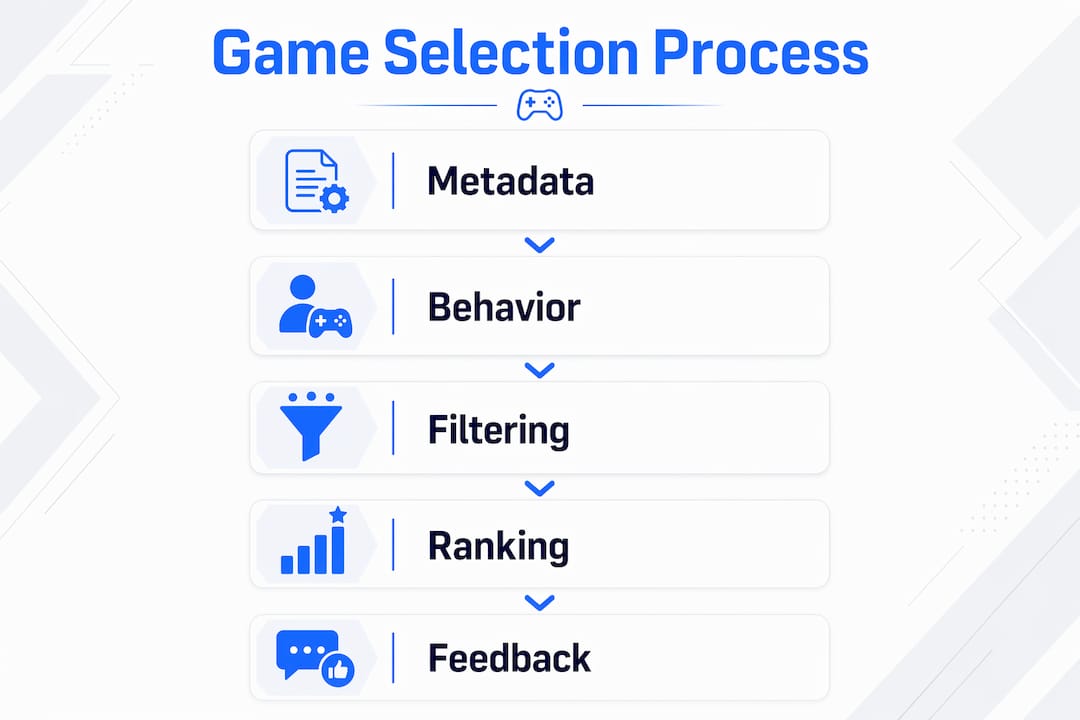
Discovery algorithms use multi-stage ranking systems that filter by safety and age before ranking by behavioural signals like play history and wishlists. That ordering matters. Safety filtering happens first, so inappropriate content never reaches a player's view regardless of how strong the behavioural match might be.
The ranking process works in distinct stages:
1. Safety and age filtering removes any content that does not meet the platform's content policy or the user's age settings.
2. Catalogue indexing organises remaining titles into precomputed lists such as trending, top-rated, and new releases.
3. Behavioural scoring ranks titles based on your play history, wishlist, and click patterns.
4. Social and contextual adjustment weights results by what your friends are playing or what is popular in your region.
5. Final ranking surfaces the most relevant titles in your discovery queue, search results, or "more like this" section.
Precomputed discovery lists are key for scalable, safe content delivery. Rather than calculating every recommendation in real time, platforms prepare ranked lists periodically and serve them instantly. This keeps the experience fast even when the catalogue contains tens of thousands of titles.The feedback loop is what makes algorithms improve over time. User interaction trains the algorithm, so intentional play and wishlist additions significantly improve personalisation. Every time your group launches a game, rates it, or adds it to a list, the platform recalibrates its model of your preferences.
Modern platforms also use what some developers call "Gameplay DNA," a tag-overlap scoring system that measures nuanced resemblance beyond genre labels. Two games might both be labelled "action," but one is a fast-paced solo shooter and the other is a slow, tactical co-op experience. Gameplay DNA scoring separates them accurately, so your group does not waste time on mismatched suggestions.
Pro Tip: Rate games you have already played, even briefly. Negative ratings are just as useful as positive ones. They tell the algorithm what to stop showing your group.What factors matter when choosing a platform for group gaming?
The best platform for your group depends on game type, session length, and social needs rather than popularity alone. A platform with millions of users is useless if it does not support the devices your group actually owns.
Business model is one factor that directly affects what games are available to you. Revenue splits vary widely, with some platforms taking a 30% cut from developers while others charge between 0% and 10%. A higher platform cut means developers may price games higher or limit features on that platform. Knowing this helps you understand why the same game can feel different across storefronts.
There is also an important technical distinction worth understanding. Launchers manage local files and DRM, while storefronts handle transactions. Some platforms support DRM-free play, which means your group can run the game without needing the launcher active. That distinction matters when one player is on a slow connection or a restricted network.
Cloud gaming platforms stream games from servers to any device, removing the need for native ports and easing multi-device group play. Cloud streaming reduces the compatibility gap between a player on a high-end PC and one on a budget laptop. It is not a perfect solution, but it significantly lowers the barrier for mixed-device groups.Key factors to weigh when selecting a platform for group play:
- Crossplay support: Does the platform allow PC, console, and mobile players to join the same session?
- Session length fit: Does the platform's catalogue include games suited to your group's available time?
- Device compatibility: Can every member of your group access the platform on their current hardware?
- Social features: Does the platform support voice chat, friend lists, and group invites natively?
- Cost and access model: Are games available through a subscription, one-time purchase, or free-to-play?
For groups with mixed devices, cross-platform compatibility is the single most important factor. A game that only four out of five friends can access is not a group game. It is a problem.
How do these platforms enhance the group gaming experience?
The group gaming experience improves when platforms combine personalised recommendations with tools that account for every player's device and preference. Pickthe is built specifically around this problem. It holds over 6,000 games in its database and lets your group swipe through options together, with each player voting on titles in real time. The result is a decision your whole group reaches in minutes rather than hours.
Behavioural data improves group recommendations over time. The more your group uses a platform, the better it understands the overlap between individual preferences. A platform that knows one player loves short co-op sessions and another prefers competitive modes can surface games that genuinely satisfy both. That kind of nuanced matching is what separates a well-designed selection platform from a simple search bar.
Pickthe's crossplay compatibility checker removes one of the biggest friction points in group gaming: figuring out which games actually work across your group's mix of devices. Rather than manually checking each game's store page, your group enters their platforms and gets a filtered list of compatible titles immediately.
Best practices for getting the most from a group game selection platform:
- Set your platforms upfront: Tell the platform which devices each player uses before browsing.
- Use the veto system: If one player strongly dislikes a genre, veto it early to avoid wasted votes.
- Engage with recommendations: Rate games after each session to sharpen future suggestions.
- Filter by session length: Match the game to the time your group actually has, not the time you wish you had.
- Revisit the catalogue regularly: New titles are added frequently, and a game that was not available last month may be the perfect fit now.
Platforms that support finding games for mixed groups do more than recommend titles. They reduce the social friction that comes from one person dominating the game choice. Equal input from every player leads to better sessions and fewer dropped connections mid-game.
Key takeaways
Online game selection platforms work best when your group actively engages with them, because every interaction sharpens the recommendations your group receives.
| Point | Details |
| --- | --- |
| Metadata drives discovery | Platforms evaluate up to 69 dimensions including session length, social mode, and complexity to match games to groups. |
| Algorithms filter before they rank | Safety and age filtering happen before behavioural ranking, so inappropriate content never reaches your view. |
| User interaction improves results | Rating games and adding wishlists trains the algorithm to surface better group recommendations over time. |
| Platform choice affects access | Revenue models, DRM policies, and crossplay support all determine which games your group can actually play together. |
| Group-specific tools save time | Features like real-time voting, veto systems, and crossplay checkers reduce game selection from hours to minutes. |
The part most groups get wrong about platform selection
Most groups treat game selection as a last-minute decision. Someone shares a name in the group chat, two people say yes, one person says they do not have it, and the whole process starts again. That pattern is not a social problem. It is a data problem.
The platforms that solve this well are the ones that collect group-level data, not just individual preferences. When a platform knows that your group spans three different consoles and prefers sessions under an hour, it can filter out the noise before you even start browsing. That is a fundamentally different experience from searching a generic catalogue.
What I have observed is that groups who engage intentionally with selection platforms get noticeably better results within a few sessions. The algorithm is not magic. It responds to input. Groups that rate games, use wishlists, and set their device preferences correctly get recommendations that feel almost hand-picked. Groups that skip those steps get generic suggestions and blame the platform.
The other thing worth saying plainly: platform fragmentation is real, and it is not going away. PC, PlayStation, Xbox, and Nintendo players are not going to converge on a single ecosystem. The practical answer is not to wait for that to happen. The practical answer is to use tools built for mixed-device groups from the start. Pickthe was designed with that reality in mind, and it shows in how quickly a group can go from "what should we play?" to actually playing.
> — Pickthe
How Pickthe helps your group find the right game faster
Your group does not need to spend the first 20 minutes of every gaming night debating what to play.

Pickthe holds over 6,000 multiplayer games in its database, all searchable by platform, genre, and crossplay compatibility. The game voting app lets every player in your group swipe through options and vote simultaneously, with a built-in veto system that keeps things fair. The crossplay checker confirms which titles actually work across your group's mix of devices before anyone commits. Whether your group is into party games, MMOs, or something in between, Pickthe surfaces the options that fit everyone. No paywalls, no pressure, just a faster route to the game your whole group will enjoy.
FAQ
What is a game selection platform?
A game selection platform is a recommendation engine that uses metadata and user behaviour data to surface relevant games for individual players or groups. Pickthe specialises in group selection, combining real-time voting with crossplay compatibility filtering.
How do game recommendation algorithms work?
Game recommendation algorithms use multi-stage ranking: they filter by safety and age first, then rank remaining titles by behavioural signals such as play history, wishlist additions, and click patterns. Precomputed lists keep the process fast even across large catalogues.
What does crossplay mean for group gaming?
Crossplay means players on different platforms, such as PC and PlayStation, can join the same game session. Not all games support it, which is why using a crossplay compatibility tool before your group commits to a title saves significant time.
How do I choose the right platform for my group?
The right platform depends on your group's devices, preferred session length, and social features rather than the platform's overall popularity. Prioritise crossplay support and check whether the platform's catalogue includes games suited to your group's mix of skill levels.
Why do recommendations improve the more I use a platform?
Platforms train their algorithms on your interactions. Every game you rate, wishlist, or play updates your behavioural profile, which the algorithm uses to refine future suggestions. Groups that engage consistently with a platform receive noticeably more relevant recommendations over time.