The role of platform parity in gaming explained
The role of platform parity in gaming explained

Platform parity in gaming is defined as functional equivalence across different hardware platforms, ensuring that players on PC, console, and other devices can compete and interact on equal terms. The role of platform parity in gaming has shifted from a nice-to-have feature to a core design requirement, driven by the growth of live-service multiplayer titles and the expectation that your friends can join your session regardless of what they play on. Newzoo's 2025 market reporting shows that staggered releases push PC's share of a game's early audience to 89%, compared to 61% for simultaneous multiplatform launches. That gap tells you everything about why publishers now treat cross-platform consistency as a business priority, not just a technical checkbox. Understanding how parity works, where it breaks down, and where it is heading helps your group make smarter decisions about what to play together.
What is the role of platform parity in gaming?
Platform parity means functional equivalence, not identical code running on every device. The goal is that a player on PlayStation and a player on PC experience the same core game: the same modes, the same content updates, and the same ability to play together. Achieving that requires moving multiplayer infrastructure away from hardware-bound systems and towards publisher-controlled backend servers that sit between all platforms equally.This shift matters because it decouples the multiplayer experience from any single piece of hardware. When the server handles matchmaking, progression, and session management, the platform underneath becomes less relevant. The result is that platform equality in gaming becomes a software and service problem rather than a hardware one, which developers can actually solve.
The industry term for this approach is cross-platform play, or crossplay. Platform parity is the broader goal that crossplay serves. You will hear both terms used, and understanding the distinction helps: crossplay is the feature, parity is the standard that feature is meant to uphold.

How do developers achieve platform parity in modern multiplayer games?
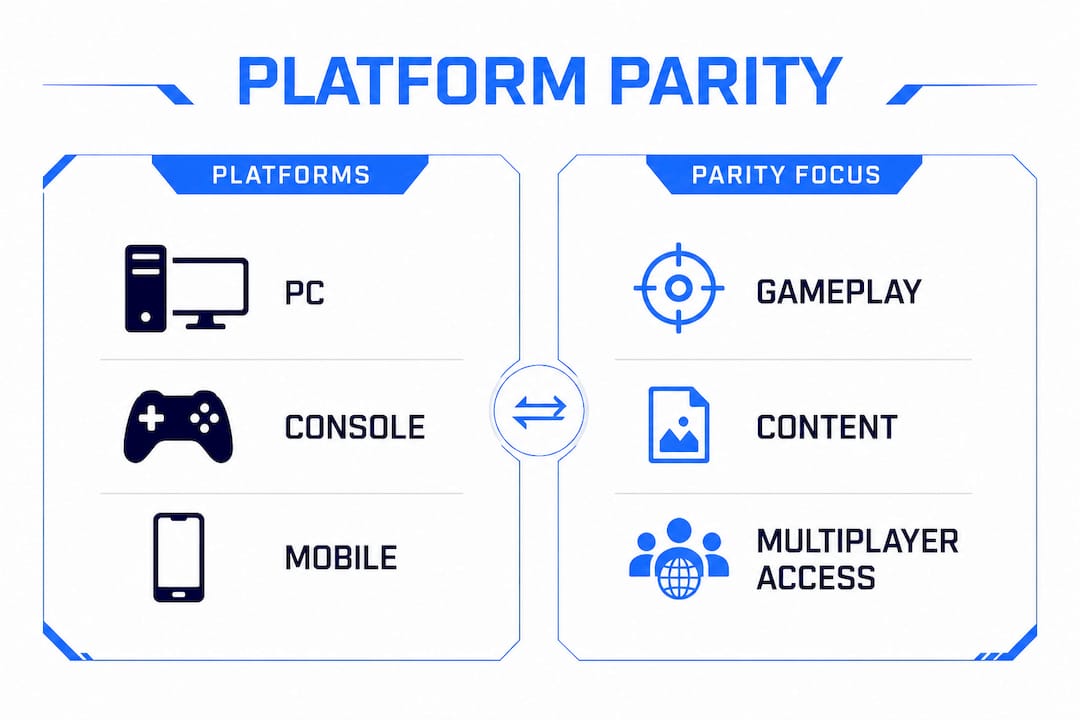
Developers build parity into a game from the start, rather than bolting it on after launch. Planning multi-platform parity from project inception involves dedicated platform specialists and separate performance budgets for each target device. That early investment prevents the costly rework that comes from trying to retrofit crossplay into a game built around a single platform's architecture.
The practical methods developers use include:
- Centralised backend servers: Matchmaking, progression, and live events run on publisher-owned infrastructure rather than platform-specific services. This gives every player the same experience regardless of hardware.
- Functional equivalence over identical features: A PC version may support higher frame rates and ultrawide resolutions while a console version uses adaptive triggers. Both versions share the same content and multiplayer access. Successful developers avoid the lowest-common-denominator trap by providing platform-specific enhancements on top of a shared foundation.
- Input-aware matchmaking: Mouse-and-keyboard players and controller players have measurably different accuracy profiles in shooters. Developers address this by grouping players by input type or by applying dynamic balancing systems that adjust hidden matchmaking ratings based on input device.
- Unified digital profiles: A single account that carries your progress, cosmetics, and friends list across every platform removes the social friction that used to make switching hardware feel like starting over.
- Simultaneous content releases: Shipping updates on all platforms at the same time prevents one platform's community from gaining a temporary advantage or experiencing a different version of the game.
What challenges and trade-offs arise from platform parity in gaming?
Achieving parity is genuinely difficult, and the gaps show up in ways that affect your group directly. Here are the main trade-offs developers and players face:
1. Hardware capability gaps. A high-end PC can render a game at 4K and 120 frames per second. A base console cannot. Developers must decide whether to cap the PC experience, accept visual differences, or build separate rendering pipelines. Most choose the third option, but it adds development cost and complexity.
2. Certification timing differences. Console updates must pass platform holder certification before release. PC patches can ship immediately. This means perfect technical parity is rarely achieved in practice. Gameplay features and live events can temporarily drift across platforms while certification catches up.
3. Input disparity in competitive play. Controller players and mouse-and-keyboard players face a genuine fairness problem in precision-based genres. Input-based matchmaking is the emerging solution, but it can fragment the player pool and increase matchmaking times, particularly in smaller games with lower player counts.
4. Feature parity versus optimised versions. Forcing identical features across platforms sometimes means the console version misses out on PC-exclusive quality-of-life improvements, or the PC version is held back waiting for a console certification cycle. Neither outcome serves players well.
5. Community fragmentation from delayed releases. When a game launches on PC first and arrives on console months later, the communities develop separately. Staggered console ports risk audience loss to PC, which is why publishers now push hard for day-one multiplatform releases.
None of these challenges make parity impossible. They do mean that "crossplay supported" on a game's store page does not automatically guarantee a frictionless experience for your group.
Why does platform parity matter for multiplayer communities?
Platform parity directly determines whether your friend group can stay together as players move between hardware. This is the social dimension of cross-platform consistency that often gets overlooked in technical discussions.
> "Players now evaluate platforms on ecosystem convenience, cross-progression, and social identity continuity. Hardware specs are secondary to whether your friends list and your progress follow you wherever you play."
Unified digital profiles and cloud-based cross-progression are industry-standard for multiplayer compatibility as of mid-2026. Roblox's 70 million-plus daily active users demonstrate what a unified identity layer can achieve at scale. When your account is the platform rather than the hardware, the importance of cross-platform play becomes obvious: you are no longer locked into a community defined by which box sits under your television.The impact on player retention is equally significant. Games that achieve genuine parity maintain larger, more stable player pools because they do not split their audience by platform. Larger pools mean faster matchmaking, more competitive balance, and a healthier long-term community. For live-service games in particular, a fragmented player base is an existential threat.
| Parity factor | Impact on your group |
| --- | --- |
| Simultaneous multiplatform launch | Everyone starts together; no platform has a head start on content or meta knowledge |
| Unified account system | Progress and friends list carry across platforms without manual migration |
| Input-aware matchmaking | Competitive fairness maintained when your group mixes controllers and keyboards |
| Centralised backend servers | Live events and updates arrive at the same time for all players |
| Cross-progression | Players can switch hardware without losing investment in a game |
The gaming cross-play advantages here are not just technical. They are social. When parity works, your group stops having conversations about who needs to buy which platform and starts having conversations about what to play next.
How does platform parity shape the future of cross-platform gaming?
Platform competition is shifting from exclusive hardware to ecosystem convenience. Players increasingly choose platforms based on where their friends are, what subscription services they already pay for, and whether their progress follows them. Hardware specifications are becoming a secondary consideration. This shift puts pressure on every platform holder to support parity rather than fight it.Emerging trends that will define cross-platform gaming in the coming years include:
- Cloud-based identity as standard. Your gaming identity, including your achievements, cosmetics, and social graph, will live in the cloud rather than on a device. This makes hardware transitions invisible to your group.
- Dynamic input balancing at scale. Hidden matchmaking rating systems that account for input device are becoming more sophisticated. The goal is a competitive environment where controller and keyboard players can share the same lobbies without one group having a systematic advantage.
- Ecosystem-first platform strategies. Console exclusives may be returning as platform holders look for system-selling points, but the broader trend is towards ecosystem lock-in through services, subscriptions, and social features rather than game exclusivity.
- Earlier parity planning in development. Studios are building cross-platform requirements into pre-production, which reduces the cost and complexity of achieving parity at launch.
- Player-driven advocacy. Gamers now actively choose games based on crossplay support. That market pressure is the most effective force pushing developers towards genuine platform consistency.
Key takeaways
Platform parity in gaming requires centralised backend infrastructure, simultaneous content releases, and unified account systems to deliver genuine cross-platform equality for multiplayer groups.
| Point | Details |
| --- | --- |
| Parity means functional equivalence | Identical hardware performance is not required; equal access to content and multiplayer is. |
| Backend servers are the foundation | Publisher-controlled infrastructure decouples multiplayer from platform-specific hardware. |
| Staggered releases fragment communities | Simultaneous launches keep player pools unified and prevent one platform gaining an early advantage. |
| Input disparity needs active management | Dynamic balancing and input-aware matchmaking protect competitive fairness in mixed-platform lobbies. |
| Ecosystem convenience drives platform choice | Players now prioritise cross-progression and social continuity over hardware specifications. |
Platform parity from where I sit
The conversation around platform parity often gets stuck in technical debates about frame rates and certification timelines. From where I sit, the more interesting question is what parity does to the social fabric of gaming.
I have watched groups dissolve because one player switched hardware and the game they all played together did not support crossplay. That is not a technical failure. It is a community failure. Parity is the infrastructure that keeps friend groups intact across hardware generations.
What I find genuinely encouraging is that the industry has moved from treating crossplay as a bonus feature to treating it as a baseline expectation. Players advocate for it loudly, and publishers have noticed. The impact of platform consistency on player retention is now well-documented enough that it shows up in publisher earnings calls.
The tension I still see is between parity and platform identity. Exclusives exist because platform holders need reasons for you to choose their ecosystem. That tension will not disappear. What I would encourage you to advocate for is the middle ground: platform-specific enhancements that make each version feel native, built on top of a shared foundation that lets everyone play together. That is achievable, and the best studios are already doing it.
> — Pickthe
Finding your next crossplay game as a group
Your group deserves a game that works for everyone, regardless of whether you are on PC, PlayStation, Xbox, or Switch. Pickthe makes that search straightforward.

Pickthe's database covers over 6,000 games, with crossplay compatibility data built in. You can browse the best crossplay games to find titles with genuine platform parity support, or explore top multiplayer platformers that work across hardware. The swiping mechanic means every member of your group votes on what to play, so no one gets overruled and no one wastes time checking compatibility manually. For mixed-platform groups, Pickthe's crossplay compatibility checker cuts straight to what your specific combination of platforms can actually play together.
FAQ
What does platform parity mean in gaming?
Platform parity means that players on different hardware platforms, such as PC and console, have access to the same game content, multiplayer features, and updates at the same time. It is defined by functional equivalence rather than identical technical implementation.
Why is cross-platform play important for multiplayer gaming?
Cross-platform play keeps friend groups together regardless of hardware. Games with genuine crossplay support maintain larger, more stable player pools, which improves matchmaking speed and competitive balance for everyone.
How do developers handle input fairness in crossplay?
Dynamic balancing systems use hidden matchmaking ratings that account for input device, grouping or adjusting for controller and mouse-and-keyboard players to maintain competitive fairness in shared lobbies.
Does platform parity mean every platform gets the same graphics?
No. Platform parity focuses on content and multiplayer access, not visual performance. A PC version may run at higher frame rates while a console version uses platform-specific features, but both access the same game modes and updates.
What happens when a game launches on one platform before others?
Staggered releases fragment the player base and can push PC's share of early players to 89%, compared to 61% for simultaneous launches. This imbalance is why publishers now prioritise day-one multiplatform releases wherever possible.